The torus: the doughnut surface
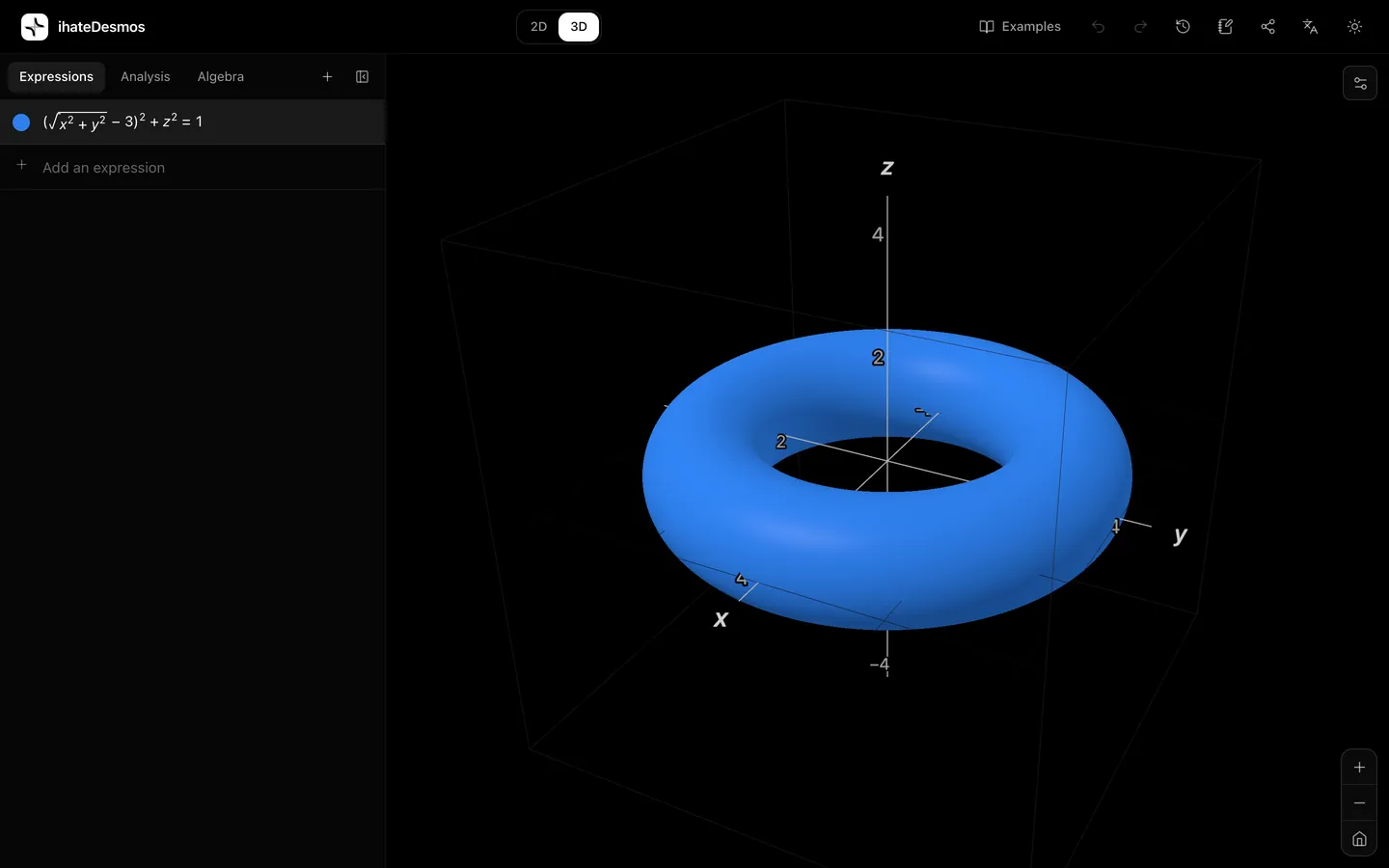
A torus is the surface of a doughnut: a circle of radius r swept around a larger circle of radius R. Its equations are a neat exercise in 3D geometry, and its volume and surface area follow from a theorem older than calculus.
Equations to type
At a glance
- Implicit equation
- (√(x² + y²) − R)² + z² = r²
- Volume
- 2π²Rr²
- Surface area
- 4π²Rr
Where the equations come from
√(x² + y²) is a point’s distance from the z-axis. The tube’s centre line is the circle at distance R from that axis, so a point is on the surface when its distance from the centre line is r: (√(x² + y²) − R)² + z² = r². The parametric form sweeps the small circle (R + r cos v, r sin v) around the z-axis by angle u.
Volume and area by Pappus’ theorem
Pappus of Alexandria, around 320 AD, found that a solid of revolution has volume equal to the area of the shape being rotated times the distance its centroid travels. The small disc has area πr² and its centre travels 2πR, so the volume is 2π²Rr². The same idea for the circumference 2πr gives the surface area 4π²Rr.
Ring, horn and spindle tori
When R > r the hole is open: a ring torus, the doughnut. When R = r the hole closes to a point: a horn torus. When R < r the surface intersects itself: a spindle torus. Add a slider for R in the implicit equation to watch the hole close.
Frequently asked questions
What is the equation of a torus?
What is the volume of a torus?
What is the surface area of a torus?
More curves
A surface with one side and one edge.
A minimal surface that repeats in all three directions.
Chaos in three equations: the butterfly effect.
Several equations that draw a heart, and why they work.
The path of a point on a rolling wheel.
r = 1 + cos θ: a circle rolling around a circle.
Every equation on this page opens in the calculator, where you can add sliders and watch the curve change.