The Lorenz attractor
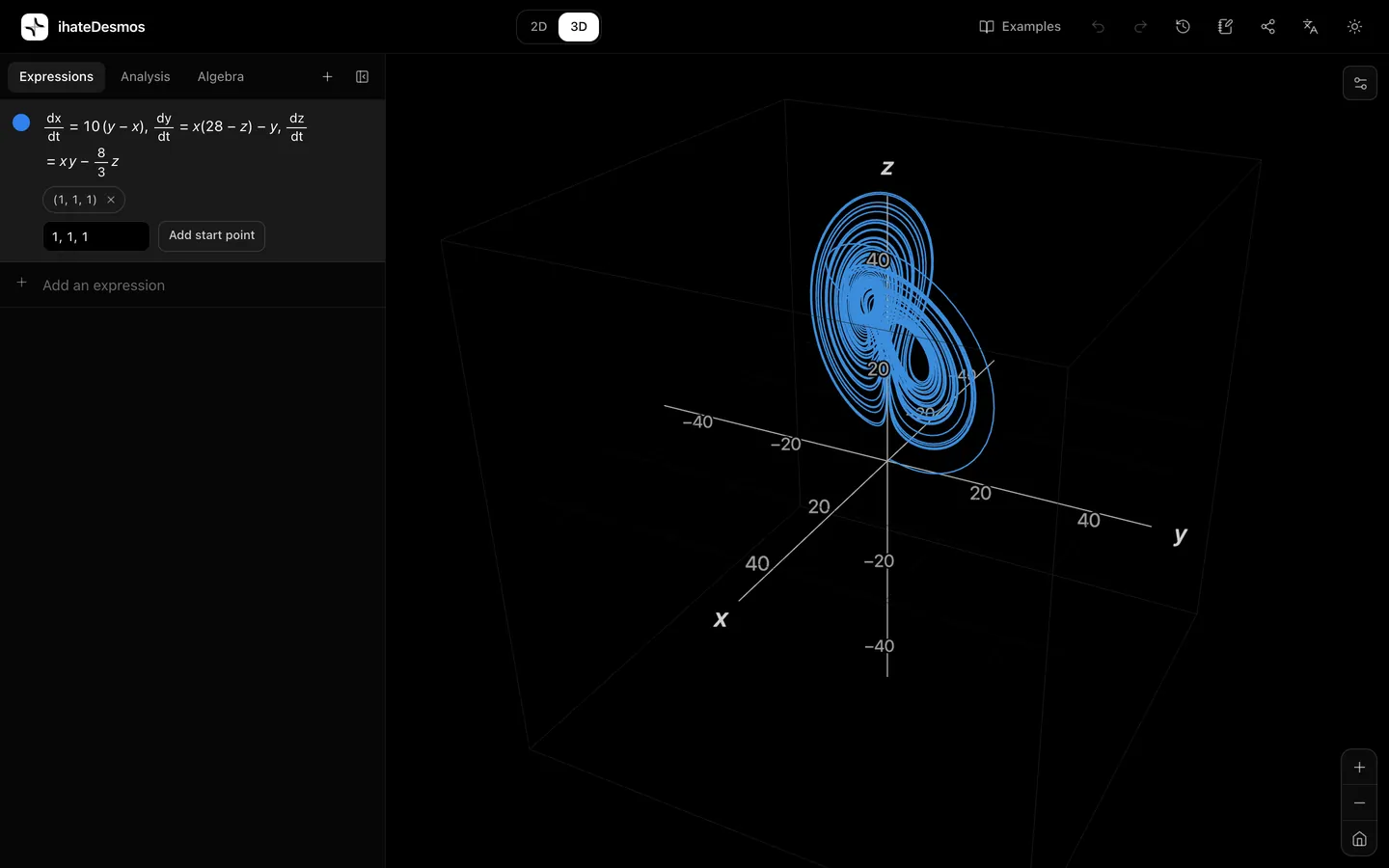
In 1963 the meteorologist Edward Lorenz simplified a model of convection to three differential equations and found that their solutions never settle down and never repeat. The path they trace, the Lorenz attractor, became the emblem of chaos theory.
Equations to type
At a glance
- Equations
- dx/dt = σ(y − x), dy/dt = x(ρ − z) − y, dz/dt = xy − βz
- Classic parameters
- σ = 10, ρ = 28, β = 8/3
- Fractal dimension
- About 2.06
The equations
x measures the rate of convection, y the temperature difference between rising and falling currents, and z the distortion of the vertical temperature profile. σ, ρ and β are physical constants; Lorenz used σ = 10, ρ = 28 and β = 8/3. Below ρ ≈ 24.74 trajectories settle to a steady state; above it, chaos.
The butterfly effect
Lorenz discovered the system’s sensitivity by accident: restarting a run from rounded numbers, he found the new solution diverged completely from the old one after a while. Two starting points 0.001 apart separate roughly exponentially, doubling their distance roughly every 0.8 time units on average, until they are on opposite wings. In 1972 he titled a talk “Does the flap of a butterfly’s wings in Brazil set off a tornado in Texas?”, and the name stuck. Open the second equation above to watch two trajectories from nearly identical starts part ways.
A strange attractor
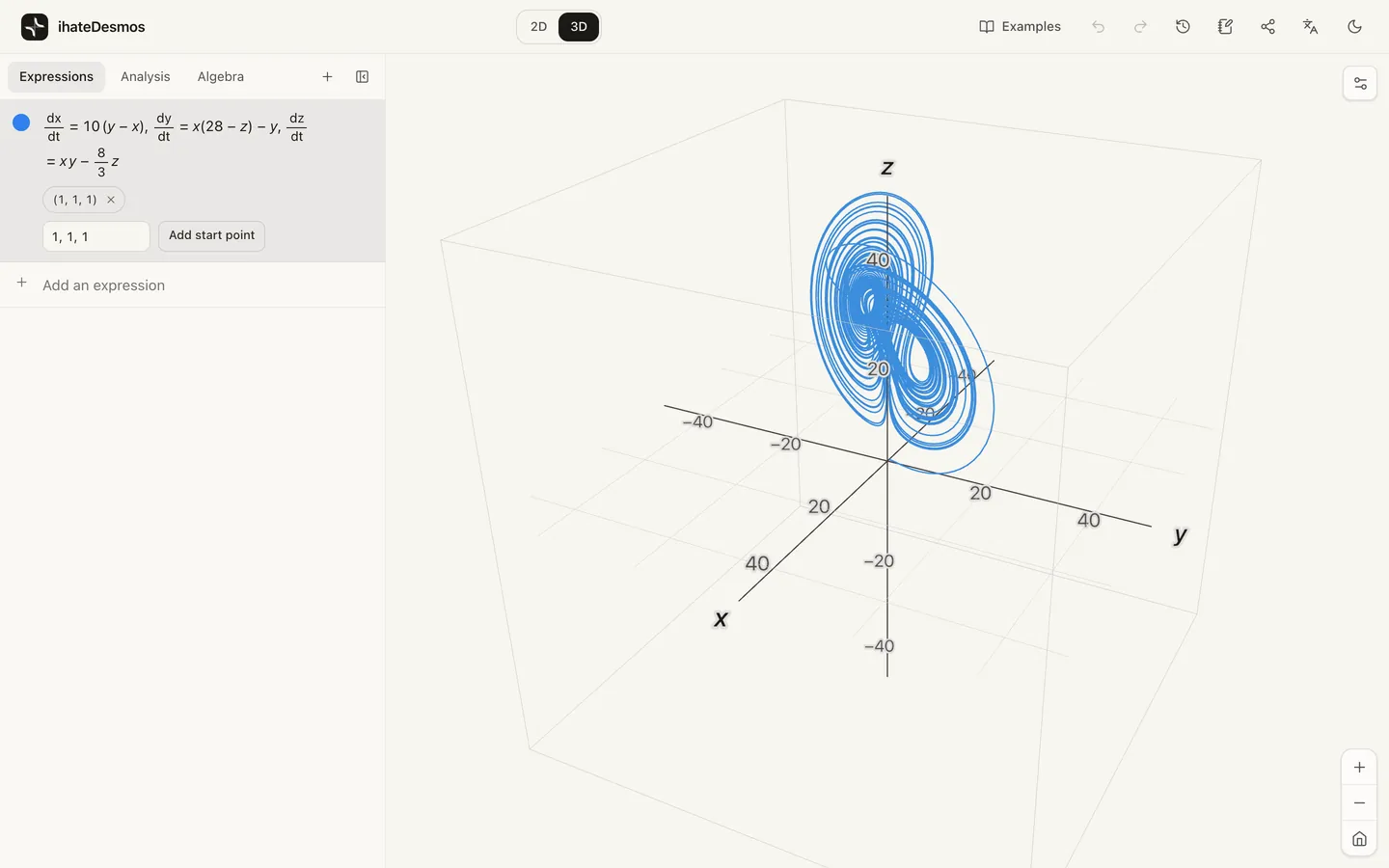
Every trajectory is pulled onto the same butterfly-shaped set, the attractor, and then circles one wing a few times before jumping unpredictably to the other. The set has zero volume but is more than a surface: its fractal dimension is about 2.06. In 2002 Warwick Tucker proved with a computer-assisted argument, using interval arithmetic, that the attractor really exists and is not a numerical artefact.
How it is computed here
The calculator integrates the system with the Dormand–Prince Runge–Kutta method, adjusting the step size to keep the local error tiny. Because the system is chaotic, any method’s small errors eventually grow, so the exact path after a long time depends on the method. The shape of the attractor, though, is robust: every accurate method fills in the same butterfly.
Frequently asked questions
What are the Lorenz equations?
What is the butterfly effect?
Why is the Lorenz attractor called strange?
How do I graph the Lorenz attractor?
More curves
A surface with one side and one edge.
A minimal surface that repeats in all three directions.
The doughnut: (√(x² + y²) − R)² + z² = r².
Temple Fay’s transcendental butterfly from 1989.
r = aθ, r = e^(bθ) and r² = θ: three kinds of spiral.
(sin at, sin bt): patterns from two vibrations.
Every equation on this page opens in the calculator, where you can add sliders and watch the curve change.