The Möbius strip
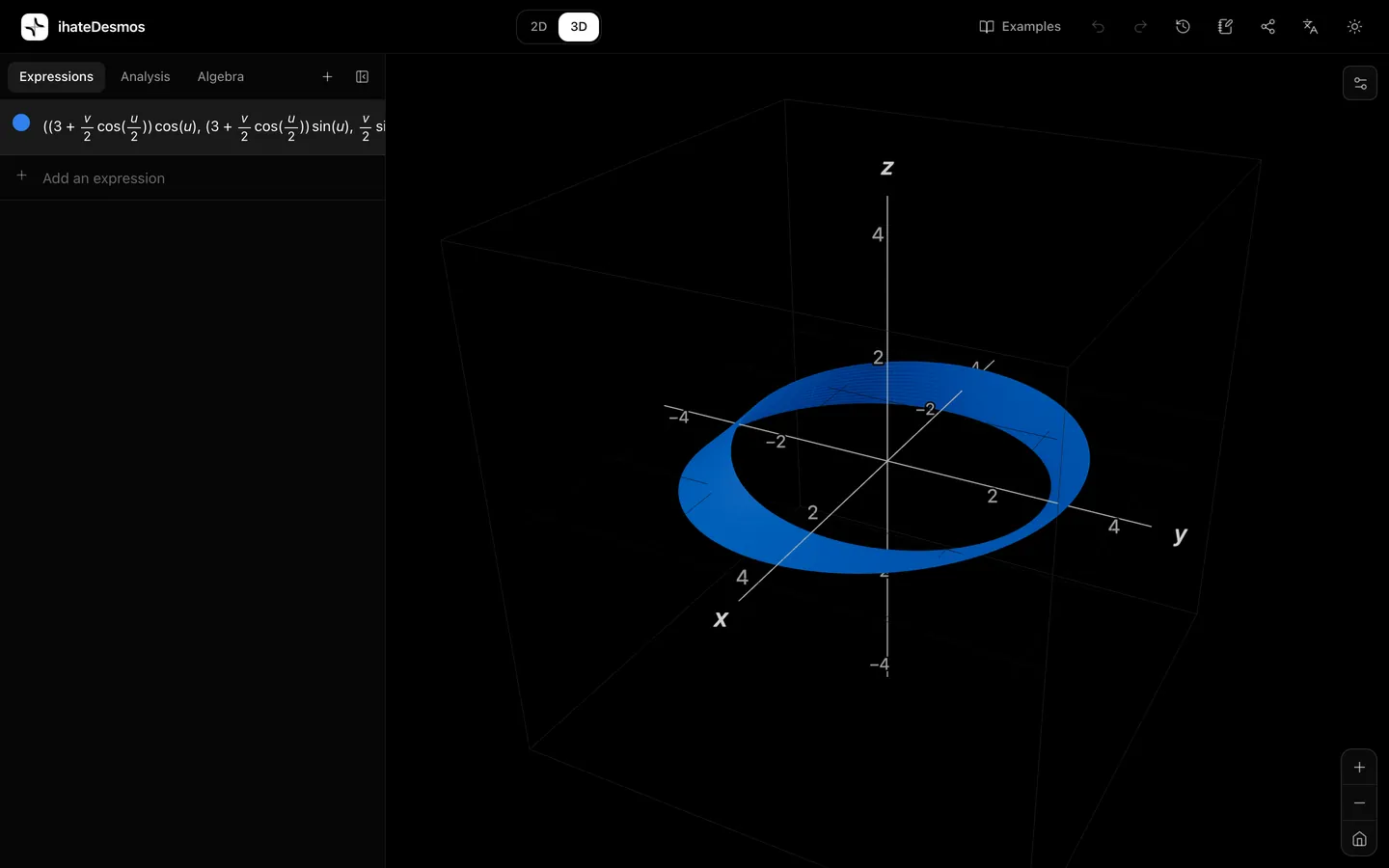
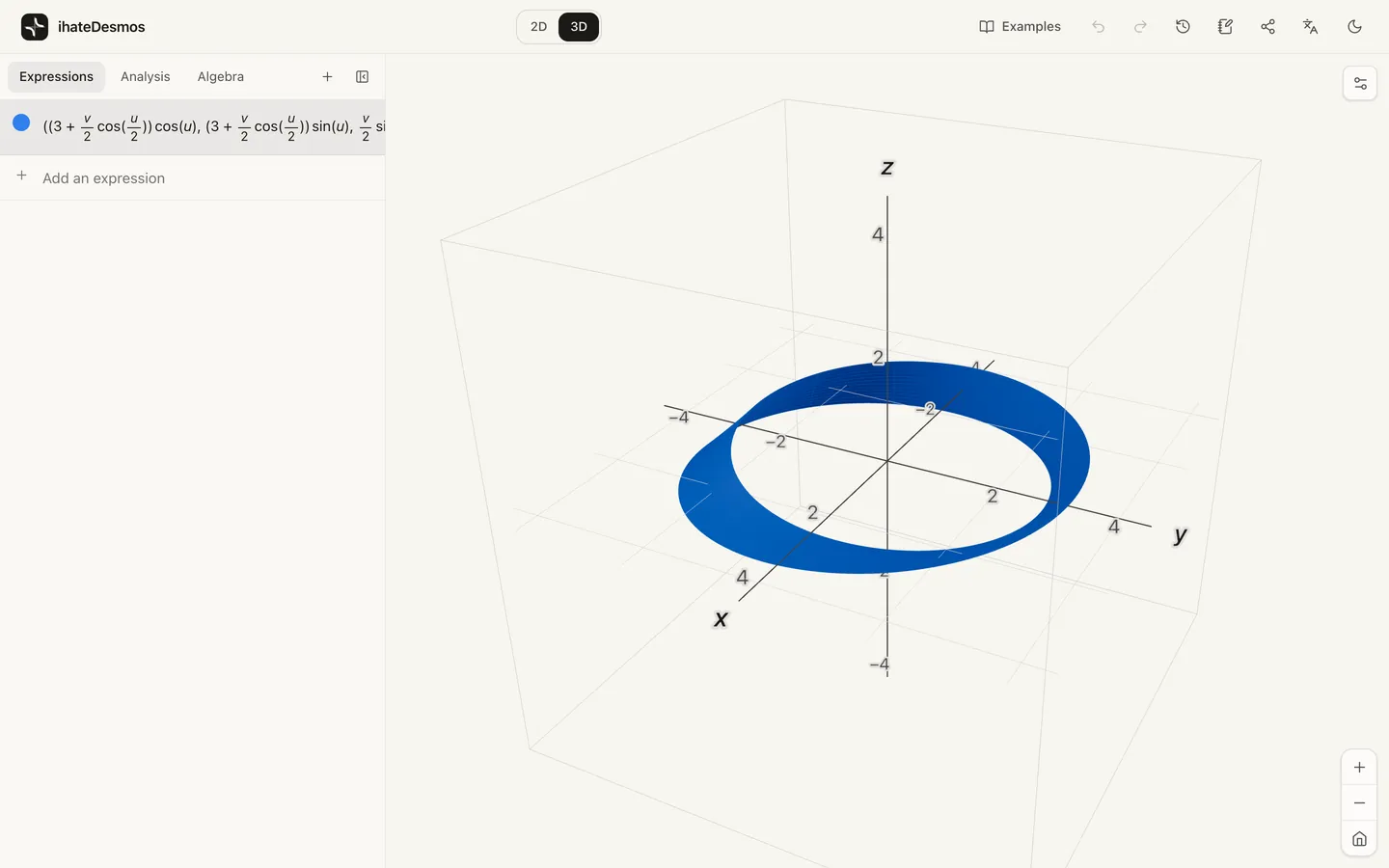
Take a strip of paper, give it half a twist and tape the ends together: you have a Möbius strip, a surface with only one side and only one edge. An ant walking along the middle returns to its starting point upside down.
Equations to type
At a glance
- Sides
- One
- Edges
- One, a single loop twice as long as the strip
- Orientable
- No
- Discovered
- August Möbius and Johann Listing, independently, 1858
The equation
The strip is built around a circle of radius R (3 here). For each angle u around the circle, a short line segment of half-width w is placed across it, tilted by u/2. As u goes once around, the segment turns through half a revolution, which is the half twist. That gives x = (R + v cos(u/2)) cos u, y = (R + v cos(u/2)) sin u, z = v sin(u/2), with −w ≤ v ≤ w.
One side and one edge
Start painting the strip anywhere and keep going without crossing the edge: you will paint the whole thing, both “sides”, and come back to where you started. Run a finger along the edge and the same thing happens: there is only one edge, a single loop. Surfaces like this, where you cannot consistently choose an inside and an outside, are called non-orientable.
Cutting it in half
Cut a paper Möbius strip along its centre line and it does not fall into two pieces: you get one longer loop with two full twists, which is two-sided. Cut a strip a third of the way in from the edge instead and you get two interlinked loops, one a Möbius strip and one a longer two-sided band. These are good experiments to try before looking at the explanation.
Where it shows up
- Conveyor belts and old typewriter ribbons made as Möbius strips wear evenly on both faces, because there is only one face.
- The international recycling symbol is drawn as a Möbius strip.
- M. C. Escher’s 1963 woodcut Möbius Strip II shows ants walking along one.
Frequently asked questions
What is a Möbius strip?
What is the equation of a Möbius strip?
What happens if you cut a Möbius strip in half?
Can I 3D print a Möbius strip?
More curves
The doughnut: (√(x² + y²) − R)² + z² = r².
A minimal surface that repeats in all three directions.
Chaos in three equations: the butterfly effect.
The path of a point on a rolling wheel.
Several equations that draw a heart, and why they work.
r = aθ, r = e^(bθ) and r² = θ: three kinds of spiral.
Every equation on this page opens in the calculator, where you can add sliders and watch the curve change.